An Article By Joesph Freeman

Editor’s Note: The New Masses Editorial Board is reprinting this article written by Joseph Freeman that appeared in the April 1933 Edition of New Masses due to its parallels to today. Like nearly a century ago, monopoly capital is now moving full force to destroy every last democratic institution while a strong-man promises help to the working class, but in reality carries out the agenda of the capitalist class.
The world crisis of capitalism which set in during 1928 swept the entire capitalist system. It affected all forms of economic life. In every capitalist country production declined drastically; foreign trade fell off; unemployment increased by the millions from year to year; wages were cut more extensively than in any previous crisis; prices collapsed; large sections of the middle class were proletarianized; the poverty and misery of the masses of the population in every capitalist country increased.
The timing of the crisis and its specific affects vary from capitalist country to country. In Germany, the weakest link in the present system of advanced capitalist states, the crisis came with unusual force. By the spring of 1932 production was about one half what it was in 1928. Prices declined more slowly than either in France or in Britain, so that the real wages of the German worker fell sharply. At the same time the number of unemployed increased from 1,914,000 in 1929 to 7,000,000 in the winter of 1932. In 1929 about 14.5 percent of the trade union members were unemployed and 9.4 percent partially employed; by the spring of 1932 about 48 percent were totally unemployed and 24.2 percent partially employed. During the winter of 1931-32 only one-third of the trade union members were employed full time. These figures are especially significant when it is remembered what a large part of the German working class is organized in trade unions.
The existence of a huge “reserve army” of unemployed gave the German employers the opportunity to slash wages, to increase the percentage of part-time workers, to cut unemployment relief. Never in the history of capitalist crises in the past fifty years-the Institute fuer Konjurokturforschung reported had the national income declined so universally.
The decline spared neither the income of government employees nor the income from rents nor the income from agriculture. But the worst sufferers of all in this economic catastrophe were the workers. In the autumn of 1931 the income of the working class as a whole was 40 percent below the 1929 level; living standards were 13 percent lower. Industrial workers suffered especially. Wage agreements were ruthlessly broken. Wages were slashed down to the 1925 level which means down to the level of 1900. And, with 7,000,000 unemployed starving, the employers, for all practical purposes, abolished unemployment insurance. The. German working class was hurled back into the abyss of exploitation and misery which marked the primitive stages of capitalism.
The attack on wages and living standards affected the middle class employee, too. About 500,000 middle class employees are out of work. The wages of those still employed in 1932 was down to half of the 1929 level; they were now receiving the same pay as workers. Many farmers have also been proletarianized. The present crisis has still further increased the difference between industrial and agricultural prices. The tariffs and subsidies, as was to be forseen, were chiefly to the advantage of the Junkers; while the wage cuts in the cities have so reduced the purchasing power of the urban population that the prices of many farm products have collapsed. The alliance of the financial and industrial capitalists with the Junkers has resulted in adding millions of urban and rural petit bourgeois to the elements proletarianized by the crisis. The acute misery of the German masses during the past fifteen years opened the way for a workers revolution, for a dictatorship of the proletariat. Such a revolution broke out after the war. German capitalism crushed it in alliance with the Social Democracy which influenced the majority of the workers.
The figureheads of the Weimar republic were social-democratic politicians. These spared the Junkers, the dukes, the barons, the generals, the officials of the old empire. At the same time they directed a ruthless terror against the revolutionary workers. The bloody work of Noske and Scheideman is notorious. Social Democracy – reformism – saved German capitalism in 1918. It helped pave the way for fascism.
The betrayal of the working class by the social democracy did not begin in 1918. For years before the war the social democratic leaders were busy revising revolutionary Marxism. They collected statistics on production, foreign trade, profits, wages, crises, unemployment and the growth of the middle class. These figures were intended to prove that capitalism had a long and glorious future ahead of it. The bourgeois economists maintained that capitalism was eternal. The social-democratic pundits argued that it was not eternal. Some day, in a vague undefined future, capitalism would peacefully evolve into socialism. But that day was so far distant that nothing could or should be done about it. These ideas were ,of course, garnished with .suitable “quotations” from Marx. Often the revisionists were not afraid to admit that Marx was wrong. It was “obvious” for instance, that the accumulation of capital had not resulted in an increase of misery for the masses. Crises did not cover shorter and shorter periods, each time dealing a more serious blow than before to capitalism. On the contrary, the span between crises was becoming longer and longer.
Prior to the war reformism or revisionism was the dominant ideology of the German working class movement. The social democratic leaders preached reformism not because they “misunderstood” Marx. They “misunderstood” Marx because of their privileged position in prewar capitalism. The mass of
workers followed them for the same reason. In both cases, “existence determined consciousness.” Before the war German capitalism was on the upgrade. Out of the exploitation of its colonies and foreign markets it was able to increase wages. It was this economic fact which led to the reformist illusion that by a revolution the workers had more to lose than their chains. It led to the great social democratic betrayal signalized by the voting of war credits on August 4, 1914.
The “Lesser Evil”
But the capitalists are not interested in democracy. They are interested in profit. When profit is threatened they are ready to drop the democratic mask and to resort to dictatorial measures. Besides, the crisis by deepening the gulf between the well-paid apparatus and the starving mass lessens the usefulness of the reformist bureaucrats. The worker is beginning to see the truth. The bureaucrats know this and the capitalists know this. The time will come when capital will dispense with the social-democrats and rule through fascism. But on the road to fascism the reformists are still useful. The misleaders of the workers who supported the imperialist war now support dictatorial measures. They defend the Von Schleicher regime. If we do not agree to a “legal” dictatorship, they tell the workers, we shall get something worse. Like Green and Woll in the United States, they deny that this crisis is deeper than all previous crises; they cooperate in the destruction of democratic forms on the ground that they are imperative and temporary expedients on the road to economic recovery. When the crisis becomes too acute, they transmit to the workers the bourgeois notion that it is all due to the war, forgetting to add that war is an integral part of capitalist economy.
The leaders of German capitalism did not, of course, share the illusions which their social democratic henchmen were spreading among the masses. They realized the full meaning of the economic crisis. They knew that it could easily become a political crisis menacing the capitalist system. The increasing opposition of the masses, the growing influence of the Communist Party made it necessary for capitalism to dispense with democratic mummeries and to go over to the mailed fist of fascism. Force masked by fraud had to be replaced by naked force. The transition to naked force was the “legal” dictatorship of the Junkers and industrialists through the von Schleicher and von Pap en government. Bruening with the aid of the social-democrats prepared the way for the von Schleicher and von Papen dictatorship which represented the most reactionary Junkers, bankers, industrialists, and generals of the old regime.
This “legal” dictatorship with a republican facade ruthlessly persecuted the working class organizations. But fascism requires a mass base, and capitalism found that mass base in Hitler’s Nazis. The secret of Hitler’s rise is partly to be found in the steady deterioration of the middle classes.
In the cities, handicraft workers, petty tradesmen, officials, white collar workers, intellectuals; in the rural districts, farm workers and petty farmers suffered acutely from the crisis. If the proletarianized middle classes joined the proletariat in a struggle against capitalism, the latter would be done for. It was necessary to split the middle classes off from the proletariat and to convert them into staunch allies of monopoly capital.
Hitler’s Promises
This political task, so necessary for the continued existence of German capitalism, was facilitated by the political immaturity of the middle classes, and their peculiar position in the social scheme which prevents them from playing an independent role. Furthermore, the proletarianized petit-bourgeois is unwilling to accept his new status. He is reactionary, romantic, often monarchistic. Instead
of taking his proletarianization as a basis for a political alliance with the working class against the common foe which exploits them both, the impoverished petit-bourgeois seeks to forget his social demotion or at least to conceal it. He seeks to fight his way out of the proletariat by aligning himself with the capitalist who pushed him there.
At the same time the Nazis appealed to the most elementary needs of the small farmers. The small farmer is too backward politically to realize that he cannot be liberated from interest until he is liberated from capitalism. He cannot see that a high tariff intensifies the crisis making his conditions worse. He does not grasp the connection between his own low living standards and the wage cuts of the workers and employees in the urban centers.
The small businessman, like the small farmer, does not grasp his place in the whole economic scheme of capitalism. Inflation and the crisis have destroyed him. But in his daily life he sees no further than his nose.
The Nazis are actually carrying out the policies of monopoly capital and the Junkers. But they gain a mass following by appealing to the impoverished middle classes. To their economic program, they add appeals to the basest national and racial passions. There is a great ballyhoo about the German race, the Aryan’s leadership in the culture of humanity, Teutomc blood, the Jewish menace, and above all the “horrors” of Marxism that seeks to destroy the “individual”, the “race”, the “nation”, religion, the home, and, naturally, “culture”.
The Hitler cabinet never uttered a word about “breaking the bonds of interest slavery.” No official of the new government talks of nationalizing the banks and trusts or of abolishing “predatory capital.” Not a word has been said about unemployment relief. But the Hitler government has begun to scrap the social insurance system and is preparing to institute forced labor. There have been further reductions in wages and further increases in food prices. Terror is no substitute for economic problems. The superb technical equipment of German industry rests upon a precarious foundation. The German workers, even those under social democratic influence, and the middle classes can find no relief in a government acting as an agent for the Junkers and industrialists. Capitalism resorts to fascism when it is most desperate, when its prospects are blackest, when the forces making for social revolution are strongest.
The Fascist Terror
The fascist terror against the German working class did not begin with Hitler’s assumption of the chancellorship. The Nazis have persistently carried on armed’ warfare against the Marxists, particularly against the Communists.
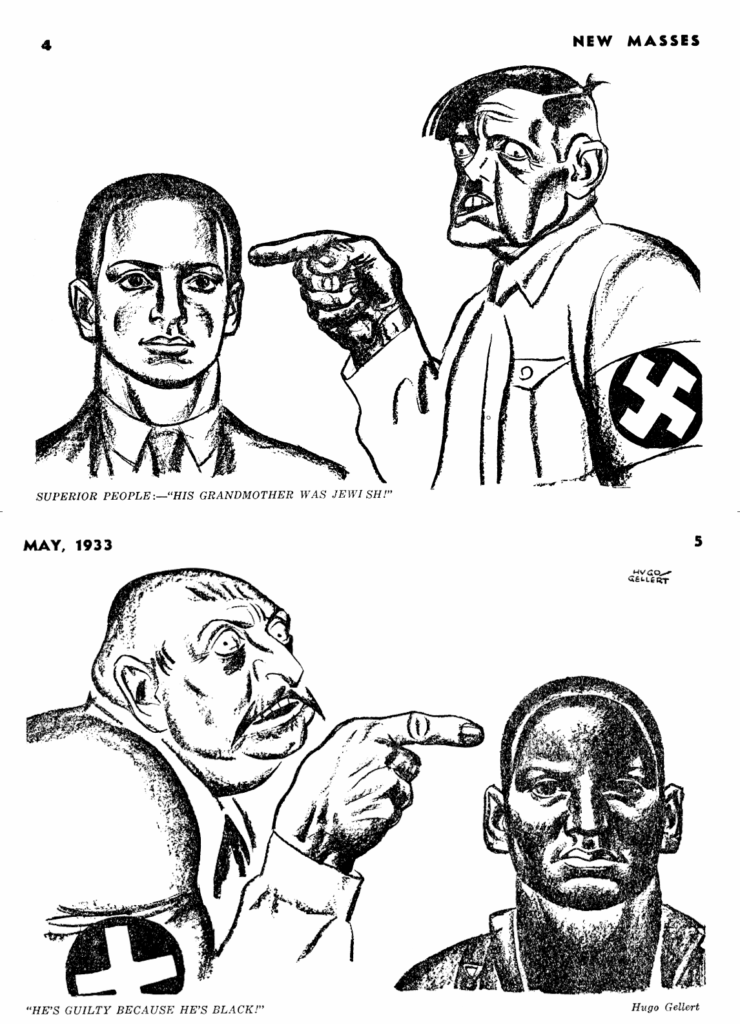
The present terror is directed against Jews, liberals, pacifists, social-democrats, as well as Communists. But its main object is to disarm and destroy the revolutionary working class organizations. Monopoly capital and the Junkers, acting through the Hitler cabinet, seek to prevent what cannot be prevented–the working class revolution. In order to extend its base in the middle classes, the Nazis play upon the worst national and racial prejudices. They have gone back to the middle ages for their ideas. The Jew is the convenient scapegoat.
The workers must protest against the persecution of Jews as against the persecution of all oppressed races, but they must remember that the chief victims of the fascist terror conducted by German capitalists are German and Jewish workers. They must do this all the more vigorously since the Jewish capitalists who are protesting the outrages against their co-religionists will not raise a finger against fascism as such. They will not say a word about the murder of revolutionary workers, German or Jewish. They will not attack Hitlerism as the mailed fist of capitalism.
Yet it must be clear to every worker that violence, barbarism, anti-semitism are inevitable under a rotting system of force and fraud which is desperately trying to stave off the social revolution.
The Nazi-Nationalist terror reveals once more that capitalism thrives on racial hatred. In Germany it incites the Jewish pogroms; in the United States it lynches the Negro. The profit system rends society into antagonistic social classes. The profiteers divide and conquer. They pit race against race; they conceal the war of class against class. Only one country in the world has succeeded in eliminating racial hatred, anti-semitism included. Only in the Soviet Union, where capitalism has been abolished, does there exist full social equality for all races.
Fight Against Fascism!
But the working class does not care for some vague idiotic abstraction which Wels calls “honor”. It wants life and liberty; and the atrocities of the fascist regime will teach it more and more that life and liberty are impossible under capitalism. They can see even amidst the protests of Jewish capitalists, of liberal groups that the life of a worker is of less consequence to the capitalists than the life of a dog. They can see in New York that a Jewish worker-soldier has not even the right to participate in a demonstration against fascism if he happens to be a fighter against the capitalist system.
There is one point in the Hitler program which should be of special interest to intellectuals, especially those who still harbor the illusion that culture is dissociated from social forces. Hitler has announced a program of “sweeping moral sanitation” for which the entire educational system, the theatre, the movies, the press and the radio will be used. “Blood and race”, Hitler said, “will again become the source of artistic inspiration ….Reverence for great men must again be hammered into German youth.” Naturally, “great men” are exclusively reactionaries–imperial generals, big bankers and manufacturers, Junkers, the chieftains of bloodthirty fascist gangs, and the ideologues who will spin out millions of words giving “philosophic” justification to the fascist regime. The schools, the movies, the theatre, literature are not to mistake an Einstein for a great man.
The fight against fascism must be conducted with the full realization that fascism is capitalism in military uniform. Those who are silent against the crimes of the fascists are in effect their supporters. Every worker, every honest intellectual, must raise his voice and exert his strength against the monster. We must do all that lies in our power to halt the persecution of intellectuals, the pogroms on Jews, the assassination of workers. And, we must not forget for a single moment-or let anyone else forget it-that the fascist terror is directed first and foremost against the revolutionary vanguard of the working class, against the Communist Party.