The 2008 U.S. financial recession brought no shortage of suffering,
debt, and hardship to the American people. Yet no less than 2 decades
later, this era is remembered by many as a time of great artistic
expression, with all types of media ranging from music, literature, film
and television considered iconic and influential to this day.
Though much of the media produced during this time was upbeat, it also
frequently reflected the opposite, giving a voice to the widespread
economic injustice experienced by ordinary people. For example, the rap
song “Rising Down” by The Roots (2008) included the lines: “I’m workin’
while the boss relaxin’ / Here come Mr. Taxman, he leavin’ a fraction /
Give me back some… Earth’s spinnin’ outta control… Everything’s for
sale, even souls.”
Today, as the U.S. currently experiences what will undoubtedly be known
as yet another recession, political art is once again on the rise. But
what is it about struggle that inspires art?
For one, art is one of the most accessible forms of expression. Anyone
with access to a pencil and a piece of paper can create something
meaningful. Just as importantly, art is also a natural human response to
social conditions and a means of communicating those conditions to
others.
From the ancient Roman financial crash of 33 C.E. to the Great
Depression of 1929, art has long since been one of humanity’s most
important tools: it conveys emotions, exposes injustice, and inspires
action. A single song, painting, or fictional story can sway a person’s
entire outlook on a subject. Take a minute to think of an art piece that
influenced you in some capacity– you’re almost certain to think of
something. This is because whether art is visual, musical, textual,
etc., art sticks in the mind sometimes better than simple facts can. Why
else has propaganda historically relied upon artistic expression?
Yet, art extends beyond a just canvas, page, or film set– it is the
behavior of the very artist themselves when confronted with injustice.
Frida Kahlo, born 1907 in Mexico City, Mexico, confronted European
beauty standards and imperialism with her paintings. In her famous work
titled “Self-Portrait on the Borderline Between Mexico and the United
States,” Kahlo paints herself standing between the two countries. On the
side of Mexico, there is natural life, ancient structures and artifacts,
and heritage. On the side of the United States, there are factories and
pollution caused by industrial capitalism.
Kahlo’s work was inseparable from who she was as a person. Her
upbringing in a multicultural family and experiences living in a country
shaped by colonization led her to join the Mexican Communist Party in
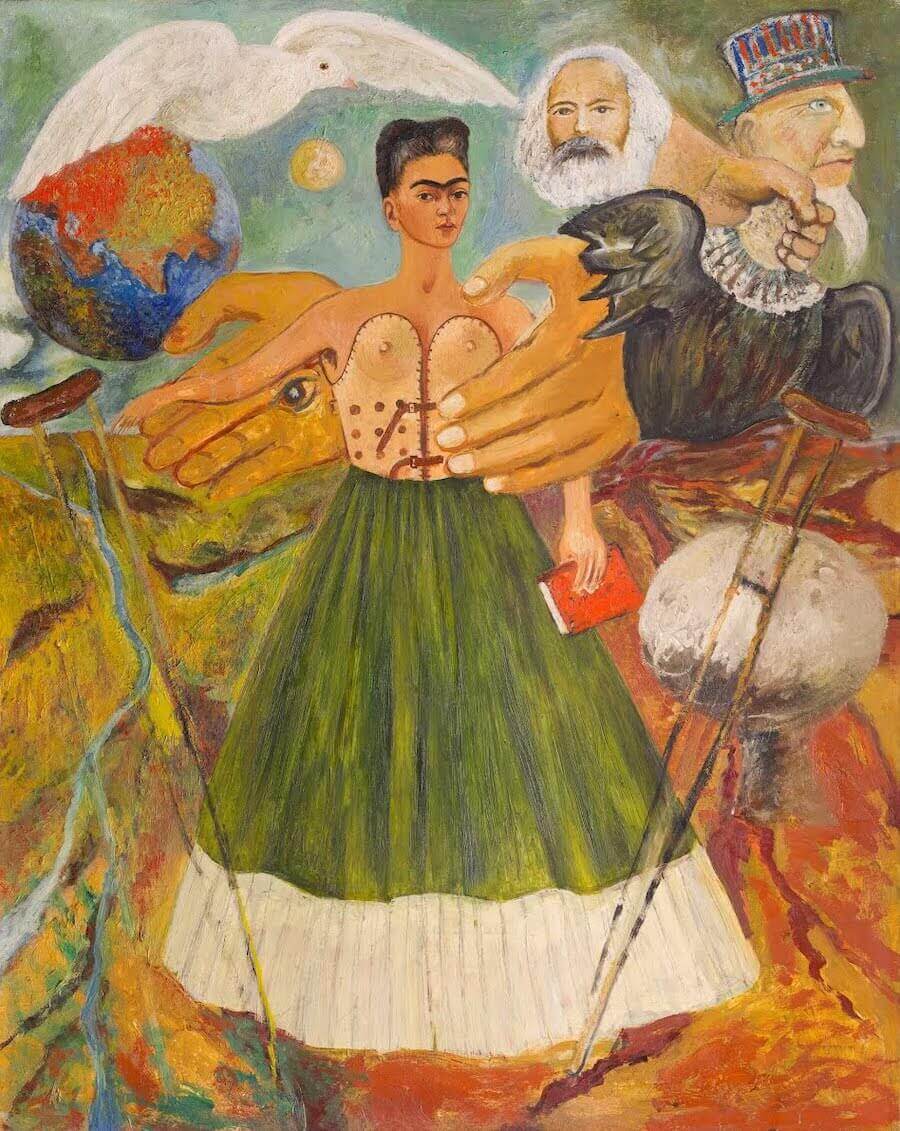
1927 when she was 20 years old. In 1954, she painted her work “Marxism
will give Health to the Sick” depicting herself being healed by the
principles of Marxism. A lifelong activist and communist, Kahlo’s
artwork was how she fought against class inequality and indigenous
oppression.